Monday, October 31, 2016

Journeys through rural Kenya: Day 3

Today was a very long day of driving.  We have a lot of ground to cover before we reach the Serengeti, so we left Nairobi at around 7:30am, and were only to arrive at our final destination by 6pm.

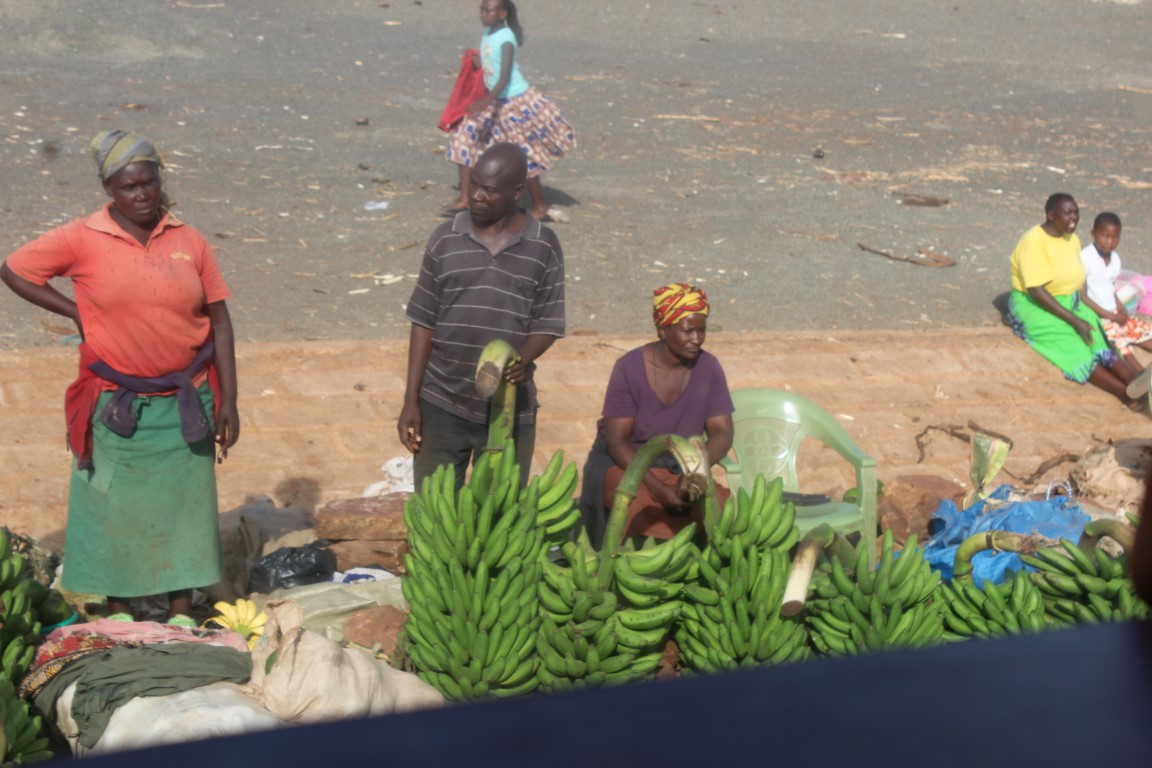
We passed through so many communities along the way.  The slums of Nairobi (tiny shacks with metal roofs where up to 10 people live in one small room), the Maasai-lands, where the ubiquitous cattle-herders roam the fields with their red robes, larger towns like Narok and Bomet, and various other communities of farmers.  And everything else in between.  The landscape constantly changed outside our large windows as our guide told bits and pieces of stories and information related to what we were seeing outside.

So many children waving hello.  We couldn't help but smile and wave back, which made them smile even wider and tug their friends to come and see.  The White People waved back to me!, it seems they must be saying.  Apparently that's what they call tourists, and often crowd the sides of tourist vehicles going on safari, shouting out for “candy” and “pens”.  Our tour company (Intrepid) practices responsible tourism and advised us strongly against giving any of these items to children.  He said it turns his nation into beggars, and causes unecessary fights and rivalries amonst the children.  He recalled a child he once knew who got into a fight with some other children over a pen and got stabbed in the eye with it.  Instead, we collect a joint “kitty” of tip-money which our tour guide distributes to all the communities we stop in who let us use their facilities along our journey.  And we wave to the children.  Waves and smiles never hurt anyone.
The Great Rift Valley

Early in the drive, we stopped at a spectacular viewpoint for The Great Rift Valley.  As you're driving along the farming landscape, it appears all-of-a-sudden; a great rift in the continent that extends all the way from Israel down to Mozambique.  It's hard to explain how breath-taking it is, even in photos.  I stood at the fence and looked out at the wild, untouched valley. I could hear it teeming with life.  I wish we could have stayed longer than ten minutes.  It's the kind of place I would just like to sit at and look off into its distance forever.

When we stopped for lunch, I spent about fiftee minutes just staring into the trees and shrubs nearby.  Very soon, the astonishing variety of birds in this country started to reveal themselves to me.  Iridescent blue and black, purple-yellow-blue, sky blue with purple and cinnamon, brown with surprise spots of red, yellow and brown speckled... every minute there seemed to be a new bird right before my eyes.  Birding at its finest.  I'll have to get out a bird book and identify these at some point during another long drive... but for now I'll leave you with photos.

We finally stopped for the night in Kisii, and settled into a small hotel for the night after a warm group dinner around a campfire – accompanied by the local Kenyan beer of course, Tusker.


Kenya has indeed been as rich and vibrant as promised.  An infinitely complex set of communities, living amidst the complex realities of their environments.  But so much colour and such happy faces everywhere we've looked.  I know it's only been a mere sliver of a taste so far, but I think I'm already hooked.  Tomorrow, it's off to the Tanzanian border.  A little sad to leave behind Kenya and its rich landscape and peoples, but excited to see what new adventures the Serengeti brings.

Saturday, October 29, 2016

Nairobi, Kenya: Day 2

Nairobi is unlike any city I have ever traveled to.
We hired a driver recommended by the sister of a friend, because a) you don't take just any taxi in Nairobi, and b) you definitely don't go walking around on your own. At least not many of the areas.
So after an early breakfast, we met Jimmy, and off we went. This morning's traffic was not too bad (it's a Saturday), and we enjoyed seeing the varied neighbourhoods and city streets. It was a mix of run down and modern – little makeshift shacks selling handfuls of bananas next to large piles of mud and debris right alongside brightly painted advertisements for modern consumer items. Old rundown shops with faded signs with a few Western establishments mixed in, like Subway or Pizza Hut.
Jimmy took us by the Canadian Embassy, and it made me smile to see the familiar Canadian flag waving amidst the tall trees in the African sky. Along the way we also passed other embassies – the US, Belgium, Czech Republic... and other beautiful, gated establishments. “This is the most expensive part of Nairobi,” Jimmy explained to us. No makeshift shacks here.
Our first stop was Karura forest. We paid the entrance fees and Jimmy told us he'd be back in two hours for us. The trails were quiet today – none of the birds or monkeys we had heard so much about. But oh, the butterflies! Every colour you could possibly imagine - “It's like we're in a butterfly conservatory,” remarked J, while I chased butterflies with my camera. My favourite was the most difficult to capture, as it rarely landed anywhere – bright, beautiful green, fluttering everywhere but in front of my lens.
It was hot, but not humid. The trees were tall and gave us enough shade so that it wasn't uncomfortable. We walked along the dusty paths, amused with ourselves for hiking in an African forest on our first day. But we wouldn't be us, otherwise.
Even African forests have geocaches!
We eventually made it to the promised waterfall, and enjoyed the coolness of the riverside as we kept walking along to the caves. Little bats hung from the ceiling, trying to sleep, while young African schoolchildren shone lights at them to try and get them to react. One yawned, ruffled it's wings a little, and went quickly back to sleep.
It was a rewarding way to spend two hours, and a unique way to experience a different side of Nairobi.
Bats in the caves in Karura forest
Jimmy was waiting faithfully for us in the parking lot when we got back out of the forest, and our next stop was Nairobi National Museum. We had to check our backpacks at the security desk when we arrived. After buying our tickets, we were assigned a guide who took us through some of the most interesting parts of the museum and gave us some wonderful explanations of everything we were seeing.
I had mostly gone for the ancient skeletons of early human ancestors. When I was in high school, I did an extensive end-of-year project on one of the most famous ones (“Lucy” - australopithecus afarensis, as well as the Laetoli footprints (ancient footprints of early human ancestors preserved in volcanic ash). Back then, the Kenya I was studying was an impossibly far away, almost mythical land, where such discoveries took place by passionate archeologists under the hot African sun – in other words, somewhere I would never go myself.
The bones of “Turkana Boy” were also there, as well as several other skulls from different periods of pre-human evolution.
Lucy and the Laetoli footprints
It was quite powerful, seeing those skeleton fragments in person. Even though they were replicas (the originals have been deeply stored away for safe keeping, due to certain religious sects demanding they be removed, and fear for the safety of the originals), it was still a fascinating look at our earliest ancestors, and a personal moment of coming full circle, for me. Back in those high school days where I was painstakingly drawing out each of Lucy's bones and colouring them in, I didn't dream of travel. I struggled with a lot of difficult things that made it hard to even see past the next day at times. I wish I could go back in time, and tell her things like, “Hey, those ancient footprints that fascinte you so much? You'll get to see them one day. In the country they come from. And so much more. Hang in there.”
Our guide took us to a few other parts of the museum as well and explained some of the history of Kenya, old customs, British colonialism, new politics. He was so excited to talk about everything he knew, and brimming over with knowledge. I highly recommend this museum. We rushed through it, so if you like museums and history, give yourself at least a good three hours, and let your guide take you on a rich tour of Kenya.
Turkana Boy
Jimmy was again waiting for us in the parking lot for our trip back to the hotel. By this time, traffic had picked up, so it was slower-going. It gave me a chance to really take in the sights and sounds of... well, being stuck in traffic in Nairobi. Unlike being stuck in traffic back home, there is never a dull moment. For starters, while there may tecnically be lines dividing the lanes, Kenyan drivers seem to take them as mere “suggestions” about where their vehicle should be, and we often found ourselves smack in between vehicles in both lanes, as he tried to get ahead of the traffic, one car at a time. Behaviour that would cause massive horn-honking back home was barely glanced at. Drivers are ruthless about not letting you cut in front, though, so you have to be ruthless back – which caused me to grip my bag tightly in fear on more than one occasion, as we were almost sardined in between two buses, narrowly missed driving into a motorcycle in the oncoming lane, bullied a bus onto the shoulder, and plenty of other near misses. (J, by the way, sat there cool as a cucumer, used to such driving madness from many other trips around the world).
Boys riding their bikes in Karura forest
And then, the street vendors! What a strange concept. As your car is stuck in traffic, people of all kinds weave in and among the cars (how they remain alive in the madness is anyone's guess), holding bunches of bananas at you, bottles of water, brightly coloured plastic table cloths, furniture... anything under the sun.
We obviously survived the drive, and I must say I was more than a little relieved to get out of that vehicle!
In the evening, we met up with our tour guide and group for the first time, and he gave us all the introductory details about our trip into the Serengeti. We then went out for dinner at the famous Carnivore restaurant - with a hired driver, of course. There is so much security in Nairobi – our hotel, the restaurant, the museum, all had gates which you could not enter until you were examined by security. This mostly included the driver simply signing in and/or showing some sort of ID; a peer into the car to see the passengers... and a mirror on a long pole checking under the car for hidden weapons. You know. The usual.
The Carnivore was interesting. It is essentially a prix-fixe meal of meat. They come around to your table and saw off pieces of meat that has been cooked on skewers. Chicken, ribs, beef, wings, pork, ox balls, crocodile... actually, the last two weren't that bad. The crocodile? - tasted like chicken. I'm serious! I always thought that was a joke. I'd eat it again. The ox ball was all right – reminded me vaguely of the chicken hearts, gizzards, and other little organs my mother used to feed us all the time as kids.
So that was Nairobi. We leave at 7am tomorrow on our tour of southern Kenya/Serengeti, and won't have wifi until we get back to Nairobi in about a week. I will, however, be writing my blogs every day while there, and posting them when I return.
Thanks for the taste, Nairobi. Maybe one day, we'll be back.


By the waterfall


My best attempt at the green butterfly

Green butterfly finally agreed to pose, but only with wings closed


Africa: Day 1

"Why Africa?" several people have asked me.

I don't really have a good answer for them, besides "animals!" and "because it's Africa".

One of my young piano student's eyes widened visibly with wonder when I started describing the trip.  "You mean you get to see animals NOT IN A CAGE?!" she exclaimed.  I smiled at that.  Yeah. Exactly. 
Someone else asked me why I was going on another trip so soon, thinking the wanderlust might perhaps be satisfied for a while after my last big trip to New Zealand & Fiji last year.
 
Those places and experiences are still with me.  The essence of the desire to travel is not necessarily the constant desire for something new.  My experiences of travel - the exhilerating 11 hour hike up the Sleeping Giant in Thunder Bay, the soul-wrenching dedication and focus of performing in the Bachfest in Leipzig, and the wonder of watching the rarest penguin in the world come out of the ocean after hours of waiting, are ever-present in my day-to-day life.  These experiences have made me bigger on the inside.  I hold worlds of stories, feelings, experiences.  I weave them into everything I do.

My home is adorned with small memories of my travels - smooth coloured pebbles from the riverside in Linz that remind me of my first experience singing on tour in Europe; a purple starfish that I occasionally hold with eyes closed and remember the Fijian sun; a tiny wooden treble clef that brings back the taste of apfelstrudel eaten outside the Tomaskirche; a large photo of Lake Pukaki's bluest-blue waters that reminds me of one of the incredible solitude of our long 5000km journey campervan-ing around New Zealand.

When days are dark and sad, I pull out these memories and go over them, and remember that I am part of a larger humanity than I will ever possibly grasp.  I don't seek travel to fill empty spaces.  I seek it to grow bigger.

So, why Africa?  I don't have an answer for what compels me.  Only that I've learned to follow those things that pull me.

I know very little of the cultural/political/social climate in the countries I am heading to.  I will watch and listen while I am there, and I will read.  For I am deeply aware that Africa is an enormously complex continent full of wildly different cultures.  Something as yet unknown to me.  And I will barely even get a taste of it.

I breezed through my first book on this long flight - "The Last Maasai Warriors: an autobiography" (by Wilson Meikuaya and Jackson Ntirkana, with Susan McClelland).  It describes the life stories of two young Maasai boys who are some of the few in their community to end up going to school (a Western school), and learn how to navigate the complicated nuances of being both Maasai warriors and Western-educated.
Our first glimpses of Africa

Excerpt:  "And you," [the prophet] said a fourth time, as I held my shaking knees.  You will one day work with the others of this world.  You will bring the Maasai story to the non-Maasai. You will be our bridge - the bridge of your generation to the world."

It is a fascinating account of a rapidly vanishing culture, and how the current young generation is embracing some Western elements (like education) in order to maintain their ways of life.  Highly recommended for anyone traveling to the Maasai region, as we will be in just a few days time.

Many people who I told about my trip expressed their long-standing desire to travel there one day.  They spoke of it as a fabled place - too remote, too expensive, too difficult.  That's what I thought once, too.  And yet here I am.

Dawn is breaking over the Sahara.  I look out the airplane window. There are too many clouds beneath us to see it properly, but the amazing brown-orange glow is enough.  We are close.

***

I'm sitting in bed in our hotel room in Nairobi, Kenya.  After almost 18 hours of non-stop traveling, we finally stepped out of the airport onto African soil.  We had a ride waiting for us, and off we went into the infamous Nairobi traffic.  My first impressions of Africa were taken in by a sleep-deprived brain, but I really did feel as if I had stepped into another world.  As the car slowly inched through traffic and made jerky stops and starts as it tried to get around other vehicles, I closed my eyes and half-dozed as the hot sun filled the car.

People came up to vehicles on the highway selling water (that's how slow-going the traffic was).  Dry grasses lined the roadsides.  Dust seemed to collect off in the distance, softening the shadows of hills int he distance.   Large trees in full bloom of startling lilac-coloured blossoms suddenly appeared around corners.  A mysterious iridescent green-blue-purple "heron-like" bird gracefully took flight amidst the trees and city buildings.  "Nairobi is vibrant," said at least two native-Kenyan strangers to us, who we encountered in airports and on the plane.  It really seemed so.  Not quite like anywhere I've ever seen.


I can't properly describe it; I'm worried it will come out framed through my Western eyes.  All I can do is try.

To all those that have ever dreamed of setting foot on African soil, seeing and experiencing the cities and savannahs, the vibrancy of the people and culture, coming face to face with the wild and the unknown of this incredible continent, these posts are for you.  I hope I do it even a little bit of justice.


Friday, October 21, 2016

Perpetual autumn

The slowness with which autumn announces itself has always been a source of comfort for me.  As someone who resists most sources of change, the gradual transition from summer into fall is appreciated.  Leaves change colour slowly; fall one at a time.  The temperatures drop gradually, and the transition feels almost seamless.

Restoule Provincial Park
There are a lot of emotions associated with autumn.  In Western societies it is tied with new beginnings - new school year, new clothes, new life adventures.  I used to always be excited for the beginning of fall - it seemed to be the one time in the year where changes were welcome; expected.  even outside of school, autumn seems to have always brought life changes: new jobs, new choirs, new homes.

This time of year is not devoid of reflection, though, and this year I seem to feel it more poignantly.  I've been reflecting on relationships and friendships that have faded.  I have been framing my particular life as sort of a perpetual autumn - the springs of new growth and opportunities and summers of full friendships and adventures inevitably lead to fading and changes.  Very little, however much I love and am fulfilled by it, seems to remain for any significant length of time.

These losses necessarily bring sadness - as if I woke up one day and all the leaves had fallen off the trees over night.  (But really I just perhaps wasn't paying attention).

But sadness is not always bad.  It is what I weave into my singing, my work, my words, my art.  I have learned to embrace it, instead of fight against it.  I have learned sadness is not something to necessarily fear.  It is a journey.  And sometimes there are new springs and summers on the other side of that journey.

In the meantime, I go on autumn adventures.  Ontario is a beautiful place to explore, and even if you never leave this province, you still won't have time to experience all of its magic.

Every fall, I go on many autumn road trips.  There's a lot of spectacular places to be discovered just an hour or two out of Toronto.  Recently we drove up to the Cheltenham Badlands.  This beautiful feature of the landscape is actually the result of human activity (over-farming).  This kind of geologic area is rare, especially in Ontario, and is under protection.  Fences have recently been erected around the area, and police often patrol the road that goes by it, preventing people from stopping the way they used to.

However, if you're up for a 20 minute walk, the Badlands can easily be seen by parking your car on the side of Chinguacousy Road (we used the part of it that is north of Old Baseline Road) and walking back down to the Badlands.  (There is also a small area of exposed badlands along this road as well).
Chinguacousy Road


Cheltenham Badlands

From the Ontario Trails website: “Badlands” is a geologic term for an area of soft rock devoid of vegetation and soil cover that has become molded into a rolling landscape of rounded hills and gullies.  Such areas are rare in Ontario and this is one of the best examples. They exhibit the reddish hue of the Queenston Shale that forms them; the iron oxide in the shale produces this colour. The narrow greenish bands that can be seen throughout the shale are due to the change of red iron oxide to green iron oxide brought on by the circulating groundwater.

Forks of the Credit Provincial Park
One of the loveliest drives in autumn that is relatively close to Toronto is Forks of the Credit Road.  This windy road goes through gorgeous trees of all kinds of changing colours.  If you want more of a walk, get off at the similarly named Provincial Park.  If you're lucky, you'll still find some wild apples on the trees along the trails.  Even in the rain, it can be a beautiful place to visit.


Higher Ground Coffee
After your drive and/or hike in the Forks of the Credit area, don't forget to make a stop at Higher Ground Coffee - a cute little coffee shop with delicious baked goods and plenty of coffee, tea, and hot chocolate options.  The seating and art are cozy and welcoming.
Higher Ground Coffee


Other places that I really love exploring are old cemeteries.  Ontario has so many of them, little plots tucked away on side country roads.  The one pictured below was especially curious - all from the 1800's, mostly very young children or infants.


And then, of course, there's fall camping.  You can use this handy website to watch the fall colours report across the province, and plan your hiking or camping accordingly.  This year, we tried out Silent Lake, and were not disappointed.  They do canoe rentals right up until Thanksgiving long weekend, and the paddling is simply spectacular.  The sweetly named lakes (Silent Lake, Second Silent Lake, Quiet Lake, and Lost Lake) live up to their names (no motorized watercraft is allowed here) and you can paddle the day away to your heart's content.


The drive to Silent Lake


 And of course, what would an autumn adventure be without delicious harvest food?  During one of our road trips, we stopped at Spirit Tree Estate Cidery and purchased pumpkin bread, pumpkin scones, apple-cinnamon buns, butter tarts, pumpkin beer, and some pork-apple burgers to barbecue back home, so we could take a little of autumn home with us.
Neat sink/tap in their bathroom


I always make a point to immerse myself in autumn this way.  Embrace the falling leaves, the end of harvest, the misty days.  Despite the accompanying myriad of feelings, this slow tumble into winter is one of my favourite times of year.


Monday, August 1, 2016

Bon Echo Provincial Park: Camping, canoeing, and the lost spiritual history of the Algonquian pictographs

Camping seems to be a Canadian birthright, one that I, as a child of immigrant parents, seem to have missed out on during my childhood.  However, when I was in my early twenties, I was invited on a camping trip with my friend and her sisters, and it is an experience I'll never forget.  We would spend the day canoeing and portaging the backcountry of Algonquin park, and set up camp somewhere new each night.  To someone that had never even been car camping before, this had a profound impact on me and likely spoiled me for car camping.

Nevertheless, car camping is better than nothing, and it is that that I have been doing for the past few years.  This weekend's camping adventure was at Bon Echo Provincial Park, a place of stunning scenery and plenty of locations to swim, hike, canoe, and explore.

We booked our campsite way back in early spring, and even then it was the very last campsite available for the Civic Holiday weekend.  It was nevertheless quite a nice campsite with ample room (we could have fit at least 2 other large tents on our site) and with enough trees and space to partially hide us from our neighbours and the road.  One of the main downsides of car camping versus backcountry camping is that during peak times, you tend to feel a little like you are sardine-canned into a small slice of nature along with all the other nature seekers right beside you.  We were lucky in that our neighbours were pretty quiet, and it let us experience the illusion of true wilderness a little easier.

Mazinaw Rock

We arrived mid-day Saturday and set up our tent quickly, then set off to try and find the lagoon boathouse where we could rent a canoe for the afternoon.  Parking was limited and signage scarce, but we eventually found our way.  Canoe rentals were cash-only, but prices very reasonable ($35 for 24 hours, $20 for 4 hours, and $10 for a quick 1 hour rental).

We paddled quickly out of the lagoon and towards the narrow channel appropriately named "The Narrows", and caught our first good sight of Mazinaw Rock.  This iconic piece of land is the gem of Bon Echo.  It is quite a feeling to be able to canoe alongside the base of it and stare up at its towering 100 metres.  We were joined on the lake by several other canoers, kayakers, and the occasional motor boat or ferry.  Everyone was there to see the pictographs - the impressive ancient aboriginal drawings on the rock that were painted to mark images seen in Vision Quests and other spiritual journeys.
As we paddled alongside the rock, we weren't quite sure what we were looking for.  We encountered a few other people who asked us if we had seen any of the drawings, as they hadn't either.  We were confused, as we knew there were over 200 along the rock that were easily viewable by boat.  Eventually, we finally spotted one.  A mysterious animal figure alongside some other markings, in ancient red ochre (ground hematite mixed with oil or animal fat).  We saw a couple more unidentifiable red markings after that.

We then paddled past where most people were looking for the pictographs and were soon quite alone on lake Mazinaw.  Just us and the impressive rocky shoreline of ancient rocks and mixed trees.  After paddling to the first portage point (which we weren't prepared to do), we slowly made our way back.  A very inviting flat rock called to us as a resting spot, and after a few minutes of struggling to point the canoe the right way and dealing with the waves caused by the motorboats, we managed to land the canoe on the rock without tipping.

We spent a good hour on this beautiful rock, just watching the water and feeling this wild place.  While we were there I took off my flip flops and hopped bare-footed up the series of boulders to a higher viewpoint.  The dried forest floor of pine needles was actually quite comfortable on my bare feet, and I leapt easily from one place to another.  My foot muscles seemed almost to sing with ancient memory of the way feet are actually supposed to move, and I admired how effortlessly I made my way up what would have been otherwise more challenging terrain had I been wearing any sort of footwear besides hiking boots.

Eventually we had to leave our lovely resting rock and make our way back along Mazinaw Rock.  Now that we knew what to look for, we paid closer attention to every faint red marking along the rock, and suddenly the pictographs were revealed to us.  We easily saw over 50 images painted on the rock as we paddled.  Sometimes we had to paddle back to take a second look or get closer or farther depending on how the angle of the sun was accenting or fading the more difficult to see images.  We were enthralled with these mysterious pictographs and tried to guess what each image was.  Later on at the visitor's centre we would learn that many of the horizontal straight lines in a row were thought to be tally marks that possibly counted the days each individual spent on their vision quest.


After this lovely afternoon of paddling, we went back to our campsite to start a fire and make our dinner.  We forgot a metal coat hangar for our sausages but we are not fussy - a sturdy branch shaped like a Y was a perfect device for cooking both sausages at once.

And it was after this dinner that I discovered the secret to making a perfect s'more.  I've had many a s'more in my lifetime, and have not once been able to say I've had a PROPER s'more, where the chocolate was actually melted.  Either the chocolate was too thick, or my marshmallow was not hot enough, or any number of other reasons.  However, we both had what turned out to be a brilliant idea - use two marshmallows, one on each side of the chocolate.  Using thin Lindt milk chocolate squares also helped the situation, I'm sure.  Regardless, my perfectly constructed s'more of goey marshmallow, melted chocolate and crunchy graham cookie was a delicious success.  These simple moments are what I live for - a campfire, a s'more, a warm night with a star-studded sky, after a full day of playing in the sun and on the water...
View of The Narrows from the top of the Cliff Top hike

The next morning we had our sights set for the Cliff Top hike, which takes you to a viewpoint on top of Mazinaw Rock, but requires boat access across to the lake to start your hike.  After a few false starts of not knowing where to buy ferry tickets, hearing the ferry's motor had stopped working, driving to get cash to rent another canoe to go there ourselves, and finding ourselves in a likely hours-long line up to wait for a canoe, we changed our plans around, abandoned the line, and headed for the beach.


Bon Echo has 3 beaches.  None of them are very big, but the water is generally clear and easy for swimming.  We avoided Main Beach which was full of noisy children and headed to South Beach, which had grass instead of sand but not nearly as many people.  We were glad for a refreshing dip in the water and swam around for a bit before relaxing on our towels and sipping on a cold beer (shh).  We did go and have a look at North Beach, and while it is smaller, you get to swim in full view of Mazinaw Rock, which much also be a very neat experience.

By this time the crowds at the boathouse had died down and we got a canoe fairly quickly.  The good thing about the boathouse is that even though it closes at 6pm, you can return boats after hours, as long as they're back before dark.  We set off across the lake (about a 10 minute paddle), tied off the canoe, and started the Cliff Top hike.  The hike is steep in parts but has a lot of staircases and handrails to help with the most challenging parts, and takes only 1 hour roundtrip, so it is quite doable.  At this point most of the crowds (it was the long weekend, after all - I imagine it's not this busy the rest of the year) had died down, so we were able to enjoy a mostly solitary hike the entire way.  A few friendly chipmunks and Chipping Sparrows kept us company as we hiked up the rocky terrain.  Most of the large rocks in this area are lined with thick veins of quartz, which makes them quite interesting to look at.
Clutes Lake
Cardinal Flowers

We reached the last viewpoint after about a half hour, and enjoyed the impressive views over Lake Mazinaw and The Narrows as we rested and had a snack/water break in one of the viewing platforms.  I am not the most agile or speedy hiker - I get out of breath, I trip a lot, I go very slowly uphill - but my determination and desire for the experience propel me forward, and I love challenging myself to ever longer and more difficult hikes.  The Cliff Top hike is a perfect "small taste" of a larger hike for anyone that wants to work up to more difficult ones, as it really is quite do-able and has the impressive views as a reward when you get to the top.  It is definitely a must-do when going to Bon Echo.


After hiking back down to our boat (have I mentioned that I adore using a canoe as a method of transportation?), we enjoyed a very liesurely paddle in the opposite direction of Mazinaw Rock (going southbound) where we discovered a handful more pictographs!  They were a pleasant surprise.  We assumed that the park doesn't bother to point people towards them because the main collection is in the other direction.  It was nice to be the only boat out this way and have the beautiful shoreline and mysterious pictographs to ourselves.  We imagined what it must have been like to have been in the shoes of the Native aboriginal people that painted these images.  If we tuned out the occasional motorboat int he distance, we could almost grasp something of that feeling of immense solitude, spiritual searching, and connection to the earth that long ago led the vision-seekers out to this secluded spot to paint their visions on the rocks for others to learn from.

The sun was slowly setting, and we quietly paddled back towards The Narrows and let ourselves float on the lake for a while as the clouds changed golden and light pink.


Children playing at The Narrows


That night, another fire, some Alphaghetti heated up in a pot on the campfire, more perfect s'mores, and another good night's sleep in the tent.  The next morning was another slow breakfast of coffee and muffins, and then we packed up our campsite before heading off to do one of the other hikes in the park - the Chutes Loop of the Abbes & Essens trail.  This is a backcountry hike that requires you to drive for a while down a dirt and gravel road.  The trail is not too challenging, but you do need a good pair of hiking shoes.  There are a few uphill spots but not too many.  The loop goes around a nice lake, and you are rewarded halfway through the hike with a little bridge that gives you a perfect view of the whole lake and provides some nice shade and cool breeze before continuing onwards.  We were lucky to be doing the hike in August when the Cardinal flowers are out - stunning deep red flowers that seem to grow near the lake and other watery areas.

Our hike back down the rest of the loop was mostly flat ground and continued near the lake for a bit.  The woods were full of noisy bluejays flying all around us, and one of them even seemed to accompany us for a good few hundred metres, flying from tree to tree just ahead of us, waiting for us to catch up, then flying ahead to the next tree, calling loudly each time, as if to tell us "come on guys, this way, this way!"

And thus ended our Bon Echo camping experience.  This is definitely a special part of Ontario.  While I enjoyed everything we did while here, my favourite part was paddling around looking at the pictographs and contemplating the spiritual history embedded in the paintings and in the towering rock itself.  They are a gentle yet powerful reminder of the lost histories of the people who lived here long before any of us ever set foot on these shores.  As the years go by, the pictographs will continue to fade.  If you have a chance, go for a day of paddling and quiet contemplation of these spiritual images painted long, long ago.  Understanding and experiencing the lost cultures of this land is possibly the truest Canadian birthright.