Tuesday, September 22, 2015

Nelson, and long-term living in a sleepervan (Day 13)

After the rather hectic pace of the past few days, it was nice to drive at a leisurely pace and take in the different sights of the South Island.  It is has less population than the North Island, and things like gas stations and cell/wifi reception points can be few and far between.

We stopped in the neat town of Nelson to stock up on supplies and to treat ourselves to lunch in a cafe.  We happened upon the Yello Cafe and decided it looked like a good place to go in.  J had a delicious grilled brie sandwich with chicken and cranberries, with a side of cajun fries.  I had the "Kiwi Burger", a fascinating pile of deliciousness served on rosemary focaccia bread: burger patty, steamed beet slices, sprouts, a fried egg, field greens and carrots, bacon, and a grainy mustard.  Needless to say that served as both lunch AND dinner for us that day.  I also had a lovely kiwifruit juice with it.  "When in Rome", as they say!

We drove some more, and stopped for the night at Old MacDonald's Farm, near Abel Tasman National Park, and spent a quiet evening preparing dinner and enjoying some much-missed internet time.

We've sort of settled into a routine.  We wake early in our little sleepervan, make breakfast on our camp stove at the back of the van, and either eat it in bed (to stay warm) or occasionally outside if there is a picnic table.  Typically I fall into the roll of preparing breakfast while Jen UNmakes our bed.  It is essentially 4 wooden panels with the bed mattress on top in the back of the van where there would have been seating.  Underneath is storage, so during the day, we remove one panel, partially unmake the sheets, etc., so we can have access to our clothing and pantry basket.

If there are hot showers available at our campsite, we take advantage of them; otherwise, we get ready for the day, brush our teeth in the small sink at the back of our van (we're equipped with a large fresh-water and grey-water storage), and off we go. 

We either snack on fruit/trail mix/granola bars (or occasionally Tim Tams!) while we drive and stop at any interesting points along the way, or find a nice place to stop and make a more proper lunch (typically a sandwich).

After the day's adventures are done, or when daylight starts to leave us, we open up our Camping NZ App (you can use it offline) to see which campsites are closeby.  They are categorized by cost.  Some are free with minimal or no facilities (usually just a place to park and a public long-drop toilet if you're lucky), while others can range between $1-$10 or $11-$20, and a few $21 and up.  The App tells you the general cost per person for non-powered or powered sights (our little sleepervan doesn't have power), and what kind of ammenities are available (communal kitchen, laundry machines, wifi, hot showers which can be paid or free, etc).  We alternate between which kind of place we chose.  It's nice to save money on the free ones, but we do occasionally need to shower and do laundry, or have use of a full kitchen instead of our little camp stove, so it's nice to have options.

We park, and typically I make dinner while J re-makes our bed and organizes the inside of the van for sleeping.  We typically have dinner in bed, as the nights can get pretty cold, especially now that we're in the South Island (it has been as cold as 2 degrees Celcius).  If there is a kitchen facility or even outdoor sink with cold water, we take our dishes there to wash them.  We have washed them in our little sink before, but it's a bit of a pain to constantly pump water and there isn't a lot of room, so if there aren't sink facilities we somtimes save the dirty dishes for the next day when we're at a better facility.

After the work is done, we get ready for bed, and typically turn on the car engine so we can run the heat for several minutes to warm up the car.  We download our camera photos from the day onto the computer, we look through them all, and occasionally play a game or write my blog before we fall asleep, exhausted from the day.

It's a simple life, in a way.  Every day life tasks take longer - changing in a public bathroom with minimal place to put all your clothing can be a tedious challenge, and there's no such thing as leaving dishes in the sink for several days because you're too tired.  Space is very limited in our little home, and things need to be constantly tidied up (e.g. the front seats become storage areas for our clothes/cameras/backpacks during the night, and need to be emptied before the day's drive).

While it has its challenges, I've rather enjoyed living in this little home so far.  Especially after a long day out adventuring, it feels like a welcome relief to come back to our little sleepervan and have no other pressing needs but dinner and sleep.

We've more or less reached halfway of our time in New Zealand, and I'm sure the next thirteen days hold more surprises and challenges.

Our sleepervan

Our bed with the curtains drawn

Cooking dinner with mountains in the background

Steak dinner in bed

Wellington, ferry crossing to the South Island, and Glow worms (Day 12)

Today we woke up in our crazily windy free campsite near Wellington, right by the ocean.  It was pretty incredible to wake up with the ocean crashing literally metres from your window.  Not so easy was trying to boil water for coffee, but somehow we managed!

What can beat waking up to this view?


Coffee, by the way, has been lacking in our campervan for the past several days.  When we first arrived in Auckland, we procured the wonderful invention of a coffee plunger, and enjoyed many a fine cup of coffee until a few days ago, we discovered a large crack in it, and some hot water poured into a cold vessel cracked the bottom straight off.  The sadness was palpable as we bid adieu to our wonderful coffee plunger.  However, yesterday J had the bright idea of stopping at a hardware store on the way to Wellington, and we found a replacement for our dear coffee plunger.  It's the little things, sometimes.

We drove around Wellington for a bit.  It was quite cold and rainy, so we went into the Te Papa museum by the waterfront, and looked around for a bit at different displays of Maori history.  There was also a section on refugees in New Zealand.  This was a very moving interactive display, with photographs, videos, poetry, and other creative writings of current refugees and their stories of hardship and hope.  Some of their stories were heart-wrenching, like one family that had to leave a child behind because he had gone to a cousin's house to play after school and couldn't be found when they had a chance to escape.  Others were endearing, like one young person's delight at eating the popular Tim Tams cookies once they arrived in New Zealand.  It was a deep and profound display, and a poignant reminder, especially in light of current events, at how incredibly painful and dangerous the life of refugees are and how it's our moral duty to do all we can to help them and give them a safe refuge.

Interactive refugee display at Te Papa Museum


We drove to the Interislander ferry docks after this, and waited in a line of cars to board the ferry with our vehicle.  It was the largest boat I've ever been on, and I was fascinated for the first fifteen minutes or so, until the severely choppy waves made me seasick for the first time in my life and I had to find somewhere to lie down until the water got calmer.

After a three hour ferry ride, we got back in our campervan and drove off the ferry and into Picton.  It was already dark, but our chosen campsite was close by, so J drove the windy rodes up the mountainside with the experise of a native kiwi driver and brought us safely to our tranquil campsite by another lake.

Picton harbour and partial view of Interislander Ferry

We had read in the reviews that this one had a small trail with glow worms on it at night, and were excited to go looking for them. After we parked, we took a short walk through the campsite to the patch of forest at the back.  Armed with flashlights, we slowly walked in the pitch darkness.  Suddenly a dot of purple appeared at the edge of my vision, and I turned.  "Glow worms!" I cried. 

And there they were.  Fantastically small pin points of blueish purple light.  Dozens of them.  It was fascinating to look at them.  They looked exactly like stars, and were just as difficult to photograph.
Some magical experiences can't be photographed.  If you come to New Zealand and have the Waitomo Glow worm caves on your list, consider skipping it and finding a forest trail like this instead.  I can't begin to explain how magical it was to walk slowly along in the woods, with a rushing stream nearby, and discover these mysterious glowing purple dots all on our own. 

My best attempt at capturing the magical glow worms
It was a special night.  A night that made me grateful for every moment of my life that brought me here.  Every wrong turn, every heart ache, every loss, brought me into this dark forest with tiny beautiful, glowing creatures, and I took in every previous second of it.

Monday, September 21, 2015

Wai-o-Tapu, Otumuheke hot stream, Huka Falls, and Tongariro National Park (Days 10-11)

It's a strange feeling, waking up every day and not knowing what the day will hold.  The days in September go by one by one, and I know that back at home, everyone I know is going about their routine.  I can even picture what I would have been doing if I were back at home.

But being on a vacation like this with no itinerary for weeks on end is something I've never really experienced before.  I've always had either a planned itinerary (when touring Europe as part of a choral group), or known the general area I was going to be staying and the general sorts of things I'd be doing in the small location I was in (e.g. spending time with family in Portugal, attending conferences in Seattle and Ohio, attending meditation retreats in Mexico).

This is completely different.  We have no idea what campsite we'll be in at the end of the night, what it will be like (it can range from just a place to park and not even a toilet, to access to communal kitchen/laundry facilities and actual flushing toilets with hot showers)... or even if our campsite will exist.  Perhaps people of different temperaments would adapt differently, but it was remarkably easy to adapt to this unknown schedule.

Last night, we needed to figure out where we wanted to go next.  Our eventual goal is Wellington so we can catch the car ferry over to the South Island, but one of the things we wanted to see, the glow worm caves at Waitomo, involved a bit of back tracking.  After some discussion, we realized that what we loved most about this adventure was the freedom to just drive and discover random out of the way treasures on our own, and not necessarily all the tours, as nice as they can be some times.  So we decided to leave the worms behind (there may be less well known opportunities to view them in the South, anyway) and continue on a meandering journey down the right side of Lake Taupo instead.
After cooking bacon and eggs (served with a side of kiwi fruit, of course) on our little campervan stove and eating it by a tranquil lake, we set off for the day.


Soon afterwards, we saw a sign with a photo of the stunning and strange Champagne Pool.  We thought we had missed our chance for this, and excitedly pulled over and made a spur of the moment decision to go into this geothermal park (Wai-o-Tapu) and view not only the fascinating orange-red and green steaming Champagne Pool, but also other pools of various colours - inky black, lime green, lemon yellow. J commented that she felt like she was walking on some strange planet.


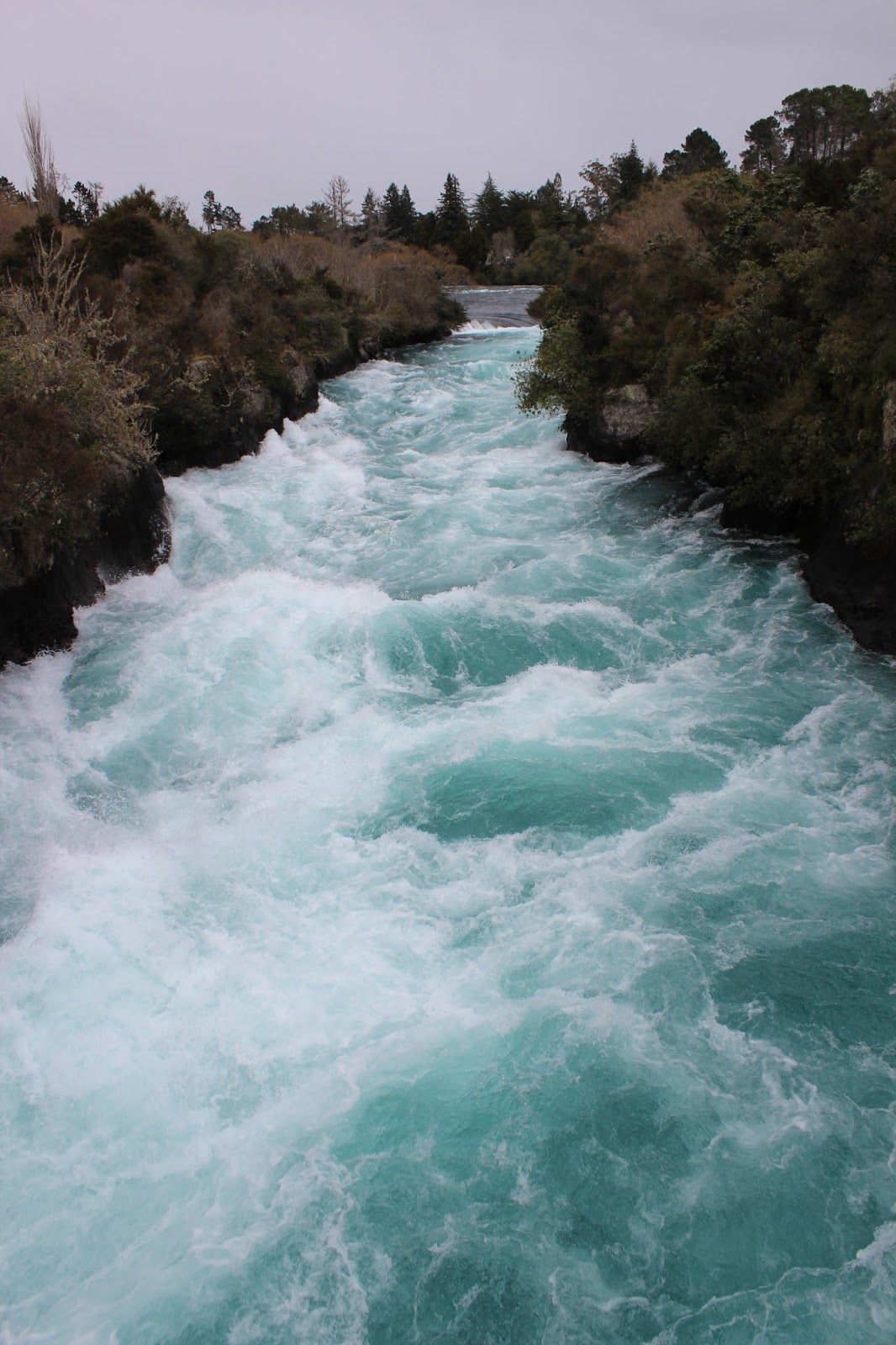
After that, we continued our drive south along Lake Taupo, enjoying the beautiful views and stopping at some lookout points, including the incredible Huka Falls, the most famous waterfalls in New Zealand.  These falls appear an incredible icy blue colour, even on overcast days.  The fantastic colour is the result of trapped air bubbles.  The massive amounts of crashing water through the narrow chasm carved in the rocks was truly an incredible sight.


As we continued our drive we saw some girls in bathing suits going for a swim in the river, and realized there were probably many hot springs around in this geothermal region of the country.  A quick turn-on of our wifi allowed us to discover a free local place to go swimming in a hot spring.  We set our GPS for Spa Thermal Park, and after a ten minute walking the blustery cold wind, we found a lake with a little waterfall pouring into a charming place to swim, with several others already enjoying the hot, steaming water.  We made our way back to our campervan to get our bathing suits to change in the public washrooms nearby, and off to the stream we went.

It was kind of a surreal experience to step out of the cold spring wind and into a hot spring.  It wasn't just warm, but HOT.  I felt like a young child discovering the world for the first time.  It just felt so FUN to be playing in a hot waterfall.  We stayed for about half an hour, just enjoying this beautiful gift from the earth.


After we reluctantly got out of the magical hot stream, we continued our drive into Tongariro National Park.  This park is home to several volcanoes, including one of the ones used as Mt. Doom in Lord of the Rings.  We drove around the park, taking a few wrong turns as I tried to decipher the best way to get to the Visitor's Centre as light was fast leaving us.  The terrain up there was fascinating - black volcanic rocks strewn across the landscape, red and gold shrubs everywhere.  The usual rolling hills with sheep had disappeared.


At no point was this landscape more foreign and strange-looking to us as when we tried to find our campsite for the night, an alleged freedom-camp spot nestled between two volcanoes.  As we slowly drove up windy roads, we started to lose visibility quite quickly, and could barely see more than a few metres in front of us into the mist.  At one point, J exclaimed "Is that snow?!"  Indeed it was.  We were driving up the volcano with no end in sight and the alleged campsite nowhere to be seen, so J pulled into a mysterious parking lot that appeared out of the mist, turned around, and drove back down to another campsite close by, with more amenities.


While we were slightly disappointed to not find our first choice of campsite, it was very nice to have access to hot showers, laundry machines, and a communal kitchen where we could have more than one pot going at the same time and actually wash our dishes with hot water.

The next day, we explored the area a little more by daylight, but were not able to see any of the volcanoes in their true glory due to the grey rainy skies full of clouds.  On our drive back down, it was interesting to see the landscape slowly change from barren black, red, and gold to eventual green hills with sheep again.  We came across some stunning, majestic green mountains that were right out of LOTR's Middle Earth, and stopped to admire them for a bit on our way down to Wellington.
We made one final stop before arriving in Wellington - Otaki Beach, a beautiful stretch of beach with softly rolling waves.  We walked along this beach for about half an hour, enjoying the peacefulness, the natural beauty of the sound of the waves, and the sunset on the water.


The North Island has been an incredible adventure. I can't believe how much I've seen and done - dolphins, hiking on the rugged northern tip, sliding down a sand dune, hiking on several volcanoes, swimming in a hot spring, watching water explode from the ground, seeing landscape change from green hills to barren landscapes to incredible blue ocean views...

It's hard to take it all in sometimes.  In a way, writing and photographing helps me take it in better.  At the end of days with so much incredible newness, it's hard to know what to even think or feel about any of it.

What is it that drives some of us to seek so much of this kind of experience?  Maybe the South Island will hold more of the answers I seek.

Thursday, September 17, 2015

Hobbiton & geothermal activity at Rotorua (Days 8 & 9)

We left Cape Reinga at 7am the next morning, gearing up for an 8 hour drive back down south past Auckland to Matamata, the town where Hobbiton is located (Lord of the Rings' largest outdoor filming set).

We took in the breathtaking scenery of the seemingly never-ending rolling hills, grazing sheep, and peaceful cows, amidst many winding roads, of course.  We wanted to arrive in Matamata before dark, so therefore allowed ourselves only one stop.  We found Langs Beach, a nice quiet beach to make and have our lunch.

Making lunch at the beach

Sheep crossing the road


We arrived on the outskirts of Matamata at sunset.  However, our chosen campsite for the night was nowhere to be found, and after circling around the suspected location in the ever-growing darkness, we called the park ranger for the site listed on the App we are using (Camping NZ).  The park ranger explained that this particular site was locked for incoming traffic at 5:30 in the winter (even though the App did not explain this anywhere), so we turned on our expensive mobile wifi in search of an alternate place to stay with our campervan that was close by, so J wouldn't have to drive in the dark that much (or do yet another 8 point turn on a highway.  Campervans are NOT easy to turn around when you've taken a wrong turn!)

Fortunately the App found us another location.  It had mixed reviews, but it was acceptable for the night, and off we went.  Sometimes things don't always work out as planned... we're learning as we go along this journey that we really have to take each moment at a time and quickly adapt to the changing circumstances.

The next day we were off to Hobbiton, where we boarded the Hobbiton bus that drove us up to the farm where the Shire in Lord of the Rings and The Hobbit were filmed.  Our first real "touristy" experience.  I personally was not disappointed.  It was fascinating to hear the story of how this particular incredible farm was chosen by Peter Jackson for the movie.  The owners hadn't even heard of the books!  The guided tour as we walked around The Shire was informative and allowed for ample photo-taking opportunities, with our guide even offering to take everyone's photos as we posed in front of various Hobbit-holes and other beautiful creations in this incredible set.  It was definitely worth doing, even if you haven't seen the movies, for the sets are incredibly designed and so detailed, and you learn all sorts of interesting bits of information.  (We even met the farm cat who was on set during filming, Pickles.  Apparently she kept jumping into the shots just as "action!" was called and had to be locked in a room for a few hours whenever they had to film a shot).

We were served a complimentary beer (or non-alcoholic gingerbeer) at the Dragon's Den when we were done, and got to see up close an incredible hand-carved dragon mural that took the artist over 200 hours to create.

Small part of Hobbiton farm set


Pickles at Dragon's Den


After Hobbiton, we liesurely made our way to Rotorua, a nearby town that is one of many in the area that experiences a lot of geothermal activity.  We paid to enter the Whakarewarewa Thermal Valley and joined a free guided tour by a local Maori woman.  We were given a very intimate and informative tour about not only the geothermal features in the area (bubbling mud pools, steaming vents in the earth), but also about some Maori cultural practices, beliefs, and ways of life.  She referred to all of us in her guided walking tour as "my family" and made sure to not leave anyone behind.

The highlight of the tour was of course our rush to the main geyser in the park, Pohutu, as it started to errupt.  This particular one goes off approximately 20 times per day.  It was an incredible sight to see gushing water come out of the ground like that of its own accord.


The hot bubbling mud pools, random vents in the earth with steam coming out, and the smell of sulphur that permeate the entire area were definitely something awe-inspiring.  It is fascinating to see the things nature creates.  Is this why we travel?  To see things that are completely alien to us?  What purpose does it serve?  Does it make me a different person now that I have seen boiling water gush 30 metres in the air completely of its own accord?  Are my neurons forever changed by the sight of brown, oozy mud mysteriously roiling and boiling in little pools?  Does being taught how to identify a Manuka tree by a Maori woman give me a microscopically different but important understanding of this tree that I wouldn't have otherwise had?

The woman who gave us our tour said that people often ask her when the nearby volcano will errupt next.  She tells them she has no idea, but that "Every day is a blessing".

With that sentiment in mind, we found our campsite for the night beside a tranquil lake and caught the tail end of the sunset, and felt grateful for the blessing of this day.

Tuesday, September 15, 2015

Cape Reinga - New Zealand's northern tip (Day 7)

Today we started our day just before sunrise, at 6am.  After having settled in early for the night in New Zealand's most northern campground (5 minutes south of Cape Reinga), we hopped out of bed and into the front seats, still in our pajamas, to catch the sunrise up at the lighthouse.

We had the entire sacred peninsula to ourselves.  We walked on the trails in those green hills slowly, enjoying the pastel colours slowly appearing across the sky as we made our way down to the lighthouse, reading the signs about the spiritual, historical, and cultural significance of this place along the way.  The Maori believe that their ancestors return back to their ancestral homeland through the roots of the 800-year-old pohutukawa tree still mysteriously clinging to the side of that rock.
This location also has another fascinating feature - it is the place where the Tasman Sea meets the Pacific Ocean.  Standing above and watching the currents of each body of water collide with each other was definitely a unique experience.


The 800 year old tree still living on the edge of the northern tip of the country

Where the Tasman Sea (left) and Pacific Ocean (right) collide
After a few hours, we went back to our campervan to make breakfast and get ready for a 45 minute hike along the peninsula down to part of the beach.  The hike itself was full of stunning views.  The rugged, wild beauty of this place is unparallelled.  Again, because we were so early, we had the entire location to ourselves.  The solitude gave us an even deeper experience than I think we would have otherwise had.

Down at the beach, we took some time to just sit and watch the crashing waves, play in them a little (still quite cold!), and admire the strange volcanic rocks that seem to make up so much of this country.


I could have stayed here all day, wandering the various trails, immersing myself in the impossibly large hills and sounds of the crashing sea/ocean.  My favourite place in New Zealand thus far.
It was just after lunch time when we finally got back to the campervan, but sometimes life is just so beautiful you forget to eat, so it was off down the road in search of the giant Te Paki Sand Dunes we had read about.  After consulting various sources, we found the road to access them pretty easily. J rented a sandboard from a kind woman in a truck full of sandboards, and off we went in search of large piles with curves at the bottom, because apparently those are the best (and safest) ones to slide down.

This is not something I would ever think to do on my own, but J's enthusiasm eventually rubbed off on me, and after watching her do it, I decided I would have a go myself.

Now, these sand dunes are huge.  We felt as if we were in the desert, trudging through the sand for 15 minutes just to find a suitable large dune, and then it takes another 15 minutes to slowly drag yourself and your sandboard to the top of one. 

I could have stopped part way and slid down a less terrifying height, but I don't do things halfway.
There I was, at the top of a giant pile of sand, holding a flimsy board, wind violently blowing sand into my eyes and mouth, trying to convince myself to push myself off.  You're supposed to get on the board on your tummy, as it's the safest (and apparently fastest) way to go down.  It was unnerving, looking down what appeared to be almost a vertical drop (it wasn't quite that - giant piles of sand can be incredibly deceiving with no point of reference), realizing I would soon be sliding down at who-knows-how-many km/hr.

Somehow, I did it.  The slide down was thrilling and terrifying.  You can dig your toes in the sand as you go down to slow yourself a bit, but I couldn't quite get the hang of it as I picked up speed.  It was an amazing thrill.  J went twice - once was more than enough for me!

That tiny dot up at the top?  That's a person - for scale.  So huge.


After that thrilling (and exhausting) experience, you'd think we'd want to settle in for the day, but there was still more to see. 

90 mile beach is an impossibly long beach along the western coast of the country near the north where we were, and it is actually a designated highway - vehicles with 4 wheel drive can actually drive along the entirety of it.  Our trustworthy 1997 Toyota sleepervan didn't make the mark, however, so we looked for another access.  We drove down from the Sand Dunes, consulting maps, guidebooks, the GPS, and even geocaching information to try and discern the closest side road access.  Finally, I found a likely option, so we turned onto a road close to Te Kao, and followed it for a while until we came to another road blocked by a large gate.  We were confused - all sources had indicted this might be a viable access, but the gate was labelled "Private", "Beach Access", and "Gold coin entry".  I hopped out for a closer look.  Sure enough, the gate was unlocked, and there was a rusty tin can with a coin slot in the top.  I rushed back to the car, grabbed a gold-coloured $2 coin, and opened the gate for J, who happily rode through.

This road was windy and longer than we had anticipated, and full of fascinating and mysterious access to other private roads and even privately built roundabouts to manage them all.

Finally, we made it to the beach.  And yes, it was completely worth it.

The sand stretched forever (90 miles of it, to be exact), and we were again completely and wonderfully alone, except for the 2 or 3 campervans we saw that would zoom by on the sand and disappear in the distance as quickly as they came.  We explored this incredible beach, jumping around in the vastness of it, marveling at the countless number of stunning shells, and again dipping our feet in the not-so-warm waves.

We spied what appeared to be an island nearby, but the tide was out so we could walk to it!  We hopped onto this tiny island (I could see the ocean on at least three sides at the same time wherever I was) and explored the patches of beach made entirely of white shells, the volcanic rocks with ocean waves smashing against them, and even saw a channel cut in between the rocks by the power of waves over a long period of time.

On the island

This channel was cut into the rocks by the sheer force of ocean power


I was amused by one of the few vans that temporarily disrupted our solitude.  They stopped near the island, hopped out for a minute or two to look at the island, and then hopped right back in and drove off.  Places to go, people to see... but we were the lucky ones, just us and this remote little island, exploring at leisure.

These are the moments to savour.  I can never be one of those tourists that hops out, takes a photo, and drives away to the next bit of novelty.  I dig my toes in the sand, watch the way the wind moves, listen to the sounds of birds and surf, smell the sea air, taste it on my lips, bend down to examine tiny curled up ferns or mysteriously shaped flower buds on plants I've never seen before and will never see again.  These are the moments I remember most, not anything I snapped a picture of.

We finally tore ourselves away from this incredible patch of 90 mile beach and drove back up to Cape Reinga to catch the end of one final sunset, and to say goodbye.  I felt still and sad, having to leave this place, but also incredibly lucky to have come here and experienced it the way I did.

Sitting on a hill looking down at the most northern tip of the country, where a sea and an ocean collide, and where the Maori believe their souls return to their ancestral homeland

Monday, September 14, 2015

Northland (Day 6)

I've been wondering how I can possibly describe the past couple of days in a way that does them justice.  I think I just need to let the words flow in whatever order they come out, not try and carefully craft them, or necessarily give a coherent itinerary.  Bear with me - I'm going to try and take you to New Zealand's Northland.

Most of Day 6 was spent driving up to Cape Reinga, but we did not take the most direct route. 
A brief stop at a waterfall, because with a sign for a waterfall closeby, how can you not stop, and see the beauty of crashing water?

Hills upon hills of green, winding roads.  So many sheep, that would rival any postcard.  Leaping lambs.  Grazing lambs.  Sleeping lambs.  Cows and sheep. Turkeys and sheep, everyone grazing up and down all those hills, roaming wild and happy and free, no sheppards for miles.

Winding roads up and down mountains.  View after view of green pastures, every single kind of green that exists.  Picturesque beyond words.  And then the ocean!  Appearing around a wrong turn , we saw it from high, high up, and simultaneously gasped at the crisp blueness, the perfect sand, the remoteness.  "Let's go there!" we both said, and go there we went.  Down, down, down the windy roads, the trees in bloom with delicate purple and pink spring blossoms, the tiny lambs ever grazing and ever leaping after their mothers, and finally we were there, at a secret beach, ocean waves crashing against rocks, against the shores, against our hearts.  This is what we came for - these wrong turns.  These incredible accidents that bring us to incredible places.  We walked along the shore in the lapping waves.

Back in the car, windy road back up,  another wrong turn.  More incredible views.  Sometimes you just have to give up the camera.  There's no way you can stop and photograph every incredible scene in this country.  The beauty is everywhere.  You just have to sit and take it all in, capture it with your heart.  Every green hill with sheep, every curious stare of a cow, every baby lamb's baa, every shade of green hill against blue sea against gold field.

We stopped for lunch at Taupo Bay, yet another ocean all to ourselves.  We even made coffee with our coffee plunger, and took our mugs for yet another walk by the waves.  This is the way to do New Zealand - don't do it any other way.  Don't just rent a car, and stay in hotels or hostels, or join a tour.  When you carry your kitchen and bed with you, you're free for things like spontaneous lunches by secret remote beaches.  You can go wherever your spirit takes you.


And then, after a day's worth of driving ever north through the beautiful North Island, we finally reached New Zealand's northern tip - Cape Reinga.

Back on New Year's day, J and I spent that morning dreaming of all the places we wanted to one day see.  I have always wanted to go to New Zealand, but that day while googling, I happened upon this incredible location.  Cape Reinga, or Te Rerenga Wairua in Maori, is a sacred place for the Maori people.  It is from this tip and through the roots of an ancient tree that they believe their ancestors return to their ancient homeland after death.  I don't know what exactly drew me here so strongly, but little did I know back on that wintry January day that this would actually be a reality for me so soon.
We reached Cape Reinga just as the sun was setting, and dashed out of the car to catch the display of colours.

...

I can't possibly describe what I felt, gazing upon this incredible location for the first time.  As the red, purple, and gold danced across the sky over the green rugged tip, the impossibly huge mountains all around us, and the picturesque white lighthouse below us, I just stood there, a few tears rolling down my face as I contemplated the incredible journey that took me here, to this dreamed-of place.  New Zealand to me was like a fairy tale, an impossible-to-reach place like the fabled Avalon.  And now suddenly here I was, seeing the rugged and fascinating northern tip of the country with my own eyes.

Why did I travel here?  The question remains. 

Maybe it was for this one moment.  For the stunning moment of knowing that seemingly impossible dreams can come true.